
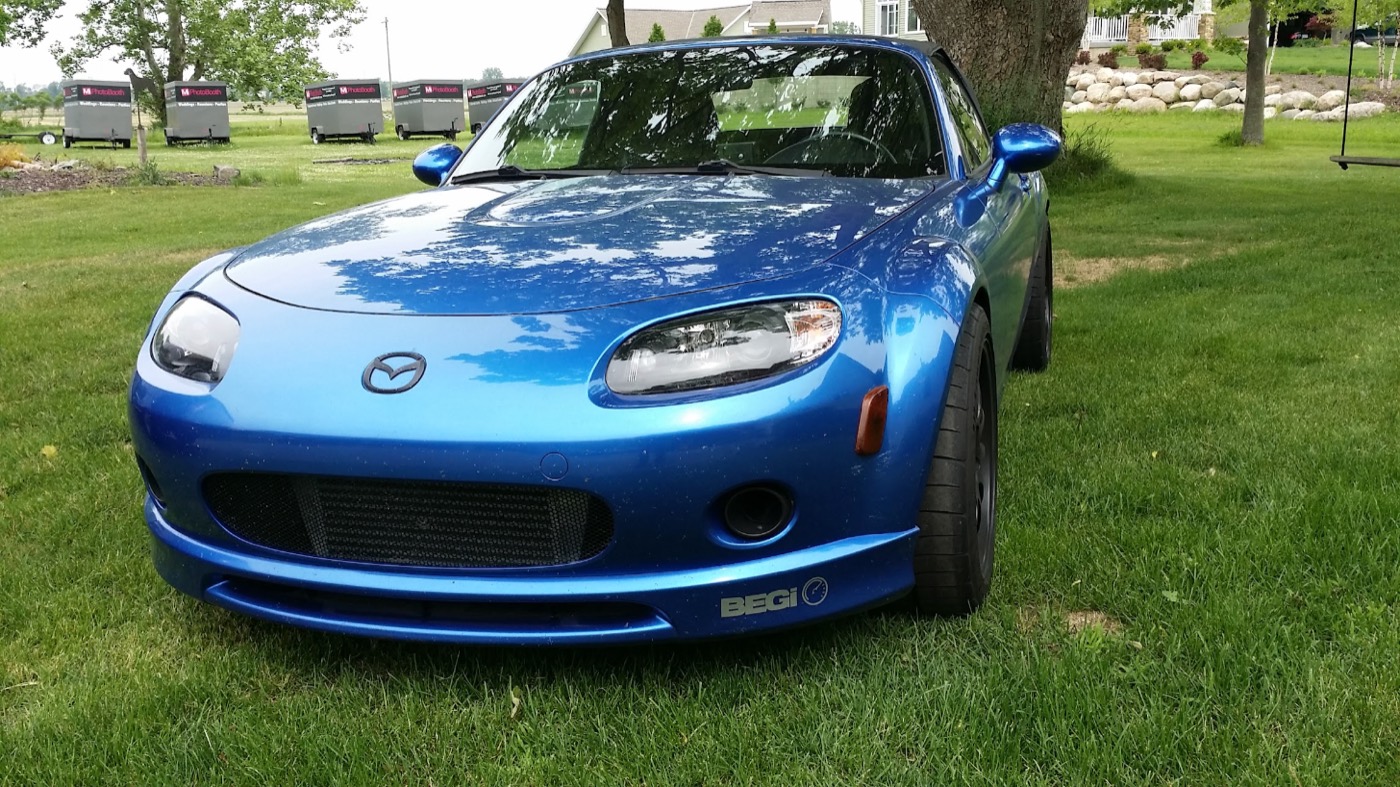
BEGi 2860
The turbo is a BEGi 2860 with miles of intercooler piping and a suck-through MAF. It went on in the summer of 2012, and the first months were spent tuning it.
A stutter that was a broken wire
Mid-way through tuning, the car started to stutter and buck at about 4,000 rpm and mid throttle. The suggested fix was a new engine harness that nobody had in stock until October.
Wiggling the coil wires one morning found it: every strand inside one wire on cylinder 3 was broken, with the insulation intact. I replaced all four coil pigtails for $67, soldered and heat-shrank the joints, and the stutter was gone. The broken wire had probably been feeding bad data into the logs we were tuning against.
THE SNAG
Stutter and bucking at mid throttle, and a harness that was months away.
THE FIX
Four $67 coil pigtails and two hours of soldering.
A real datalogger
I replaced my Dash Dyno with a DashDaq XL. It logs up to 32 parameters at about 42 samples a second, keeps 16 global parameters going whatever is on screen, and records about 23 seconds back from when you press the log button. If the car does something odd, you press log afterwards and still catch it.
It was $550, plus $100 for the Ford pack that reads knock retard. I shared my configuration files with anyone who asked.
For the first time I had a tuner, Mike at Moto-East, whose tune I was happy with when the car left. I had flashed NC ECUs around 200 times by then, on my car and on customer cars, and the old cycle of drive, log, email, flash and repeat finally ended.
The 60–100 test
I dropped my butt dyno for a measurement: 60 to 100 mph, all in 4th gear on the 6-speed. It shows power without depending on launches or driver skill, and the results repeat. A customer's supercharged car at 9.5 psi did it in 8.04 seconds.
The test also caught a customer car whose cam timing was 5 degrees out from the factory. It took 20 seconds before the fix.
In 2014 I lined up the turbo car against a 9 psi Cosworth car for a couple of videos. The turbo wins, but both cars are a blast.
“Turbos are faster, always. I've owned both modes of forced induction on an NC. I like both equally.”SEP 2013
A year of just driving
2014 was a year of a lot of driving and very little wrenching: a few suspension tweaks and no performance or tune changes. The season included about 260 autocross runs, a track day and plenty of parking-lot shenanigans.
The DashDaq showed no loss of performance from September 2013 to October 2014. The tune did not change all year. A stainless shift knob from Moto-East, heavier than it looks, made the shifts feel noticeably better.
A 3-inch exhaust, built at home
I had run a Roadster Sport mid-pipe and Q muffler since about 2008, through the naturally aspirated engine, two supercharged engines and 40,000 turbo miles on engine number 3. After six weeks of failing to buy a 3-inch system, I built one from Vibrant parts: flex pipe, V-band down pipe, an Ultra Quiet resonator and a 10632 muffler.
It fits with no rubbing and clears the braces. It pops between shifts loud enough to turn heads downtown. On a four-hour drive there was no drone, highway fuel economy was 26 to 27 mpg, and I took top time of the day at the two-day autocross that weekend.
A bricked ECU, and the end of the turbo
In May 2016 the EcuTek USB key stopped being recognised in the middle of a flash and left the car dead in the garage. Getting it running took a new key, a new licence and a new ECU. I had flashed from the side of the road and highway rest stops many times; I was lucky this one happened at home.
By then the gearbox was the weak link: I was replacing the NC transmission about every two years with the turbo, and had also broken a differential with an OS Giken in it. That is what sent the car to a V6 with a Camaro gearbox and diff.
THE SNAG
The EcuTek key failed mid-flash and bricked the ECU.
THE FIX
New key, new licence, new ECU: about $400 more, and $78 for overnight shipping.