
Retired from the route
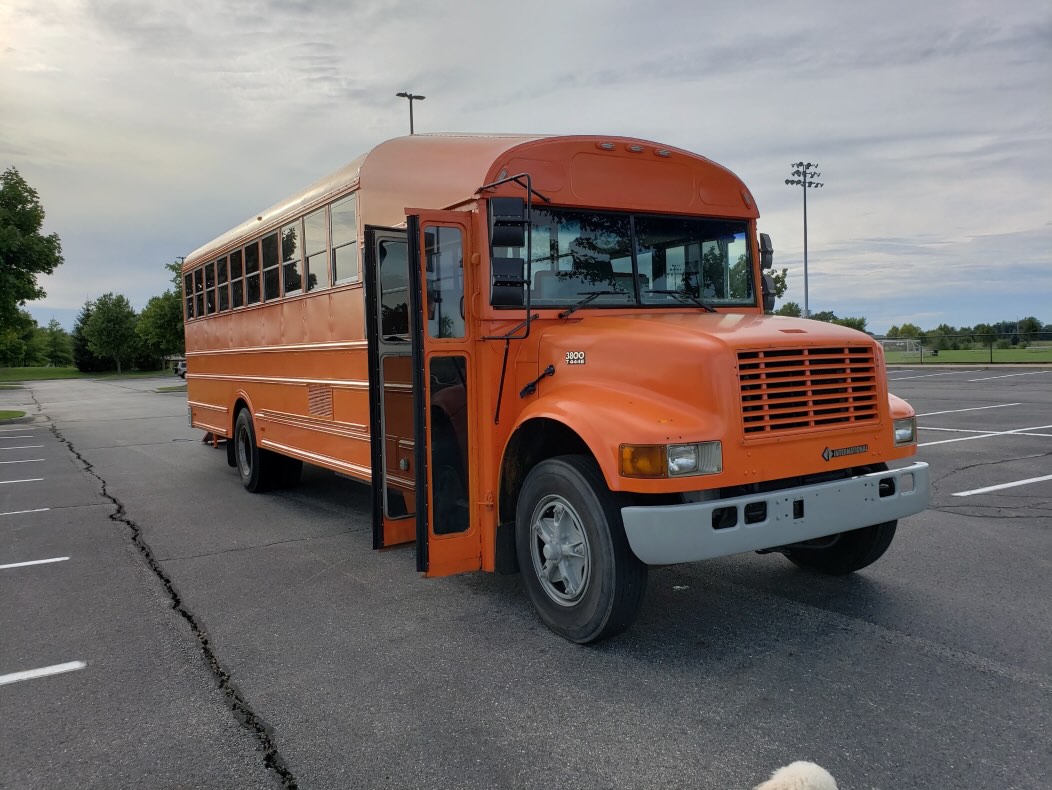
It started as a retired yellow school bus: an International 3800 with a Carpenter body and the 7.3 litre T444E turbo diesel, with an automatic gearbox.
It came home in September 2016. Within two weeks the seats, ceiling panels and window glass were out, the emergency door was off the back, and it was a bare steel cage on wheels.
Raising the roof
A school bus is built for kids, so the first big job was headroom. The roof was cut free along both sides above the windows, then lifted on threaded-rod jacks bolted between the old roof rail and the body.
With the roof up and braced, new steel went into the gap and fresh sheet metal skins went on along both sides, bent on a brake on the shop floor.
The front cap
The awkward part of any roof raise is the front, where the new, taller roof has to meet the original front cap with its marker lights. I stretched and shrank sheet metal on a disc to get the compound curve, then let it in over the old cap.
By the middle of October the transition was finished and the roof was done.
Not yellow any more
A school bus can’t stay yellow on the road, so it went orange, sprayed in the yard. The bumpers and wheels went light grey.
It was orange in time for a photo next to the other big project of 2016, the Rocket Car.
Inside the shell
Inside, the whole roof and walls got closed-cell spray foam. The rotten plywood floor at the front came up, down to bare steel.
Then the ceiling and walls went white, with overhead storage built along both sides and box fans let into the overheads for air.
A garage in the back
At the back, the rear wall was opened up for a fold-down ramp. The hinge is a long steel shaft running through welded knuckles, with heavy coil springs to help lift the ramp.
Closed, it looks like a school bus’s back end. Open, a dirt bike rolls straight in.
Finished
Finished, the back of the bus is a garage: the ramp folds down and a dirt bike rolls straight in. The breaker panel and inverter are on the garage wall.
Up front is the lounge: two dinettes with grey tables and orange cushions, which fold down into a bed. The orange fabric is surplus from Herman Miller, the office furniture maker in our town, which sells its leftovers cheap. The original STOP arm hangs on the back wall, and an air conditioner is built into one of the benches.
I built it to be modular, so things can be added or removed without affecting everything else. The overhead cabinets come down in two-door sections, so a shower could go in up to the ceiling. The space under the seats and bed was built to hold large water tanks, with an easy path for the plumbing.