
T-minus eight weeks: strip it to the frame
Every rocket starts with a booster. This one was a tired 1996 Miata, and the mission needed its engine, gearbox, subframes and suspension, and nothing else.
Within a few days the body had been jettisoned, cut into pieces small enough for a trailer. The last of the tub was towed off the pad behind the lawn tractor. The rear subframe came out as one module with the diff and suspension still on it, and every arm was cleaned, painted and fitted with new red poly bushings before reassembly.
Building the airframe
With the body gone there was nothing left holding the craft together, so it got an airframe: a steel ladder frame. Two long rails run nose to tail, with the original strut towers bolted on so the Miata suspension sits exactly where Mazda put it.
The engine and gearbox went in first as a mock-up between the subframes. By 9 June it was a rolling chassis, and the next day the radiator was mounted at the front of the stack.
The fuselage: five oil drums
The fuselage is five 55-gallon oil drums. Some stayed round and became the hull around the seat and tail. Others were cut into strips and pulled in to make the tapers, over a skeleton of steel strap with a domed cap for the nose cone.
The crew capsule is a drum cut open behind a sheet-metal bulkhead, with a Sparco seat for a single astronaut, right on the centreline of the craft.
Which raises a guidance problem: how do you steer a car when you are sitting in the middle of it? The Miata steering column and rack still sit where Mazda put them, on the left. So the steering wheel turns a sprocket, roller chain carries that to a jackshaft running across the car on two pillow-block bearings, and a second chain takes it out to the original column on the side of the fuselage.
The Miata shifter comes straight up between the astronaut’s legs, a long way below the seat, so it needed an extension. What better to extend it than a nut driver? The handle is now the shift knob. By the end of June the whole fuselage was mated to the chassis.
Fins, paint and thrust
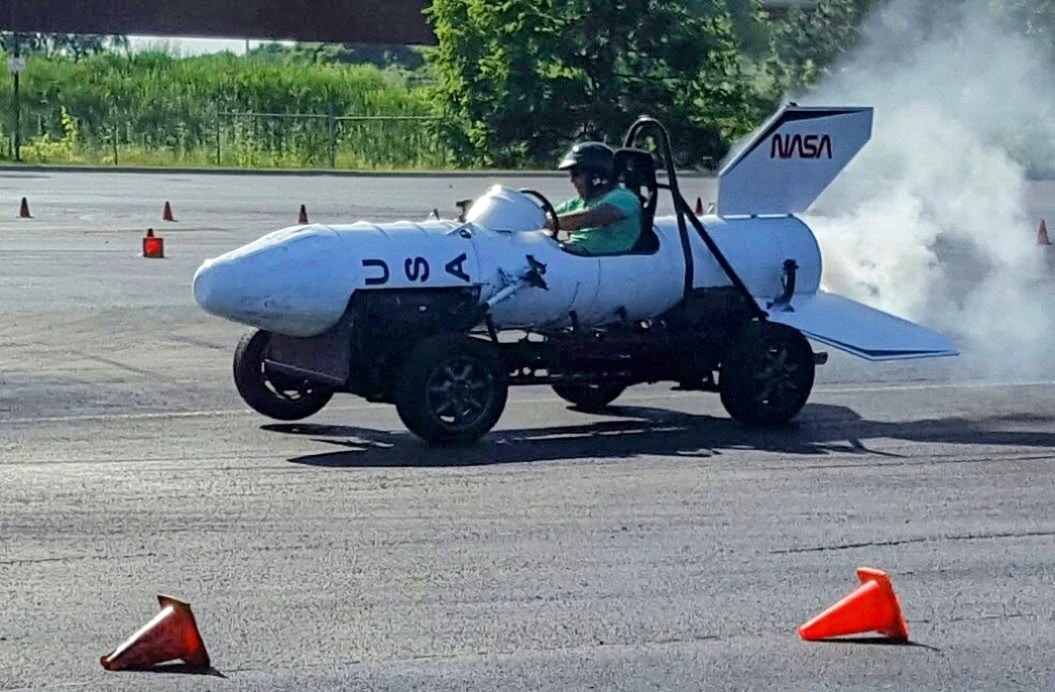
The plywood came in here. Four stabilizer fins were cut, test-fitted in bare wood, and then the whole craft went white on 28 June. A NASA worm logo went on the tall fin, USA down the nose, a red disc in the engine bell and a roll hoop behind the astronaut.
A rocket needs thrust, or at least the look of it. The tail drum hides a fog machine running off an inverter, so it can lay down a launch plume on command without anything actually being on fire.
Liftoff
First flight was 29 June: down the road and back, about eight weeks after the Miata came apart. The craft was ready for the space party, and it ended up parked by the pond, next to a smaller rocket floating on the water.
A week later came the test range: the autocross. It shared the paddock with my blue NC and laid a plume across the course.
Parade missions
Its first public mission was a parade around the Fourth of July in 2016, carrying “Jim Lilly for State Representative” signs for his campaign. The pilot wore full astronaut gear, white suit and blue helmet, and the fog machine fired the whole way down the route.
A trim, then a second life as a carrot
Low orbits around the yard were hard on the rocket. Doing donuts on the lawn, the long nose and the fins kept colliding with trees, so in the summer of 2017 it was stripped down for survival: the nose cone and fins came off and the tail was cut back.
That is how it sat for a while. Then in 2023 it got a new job. Leafy green tops on long poles went on where the fins used to be, the drums and nose were covered in orange with green stripes, and it got a CAROT CAR plate.
Same Miata engine, same ladder frame, same Sparco seat. It made its parade debut as a carrot on 13 May 2023, and lined up next to the Oscar Mayer Wienermobile.